
Future talent, judgement and internal audit leadership in the AI era w/ Tom Edwards & Maarten Stoffelen
30 Jul, 20267 minsAI is reducing the need for junior auditors. Fewer juniors hired today means fewer seniors a...

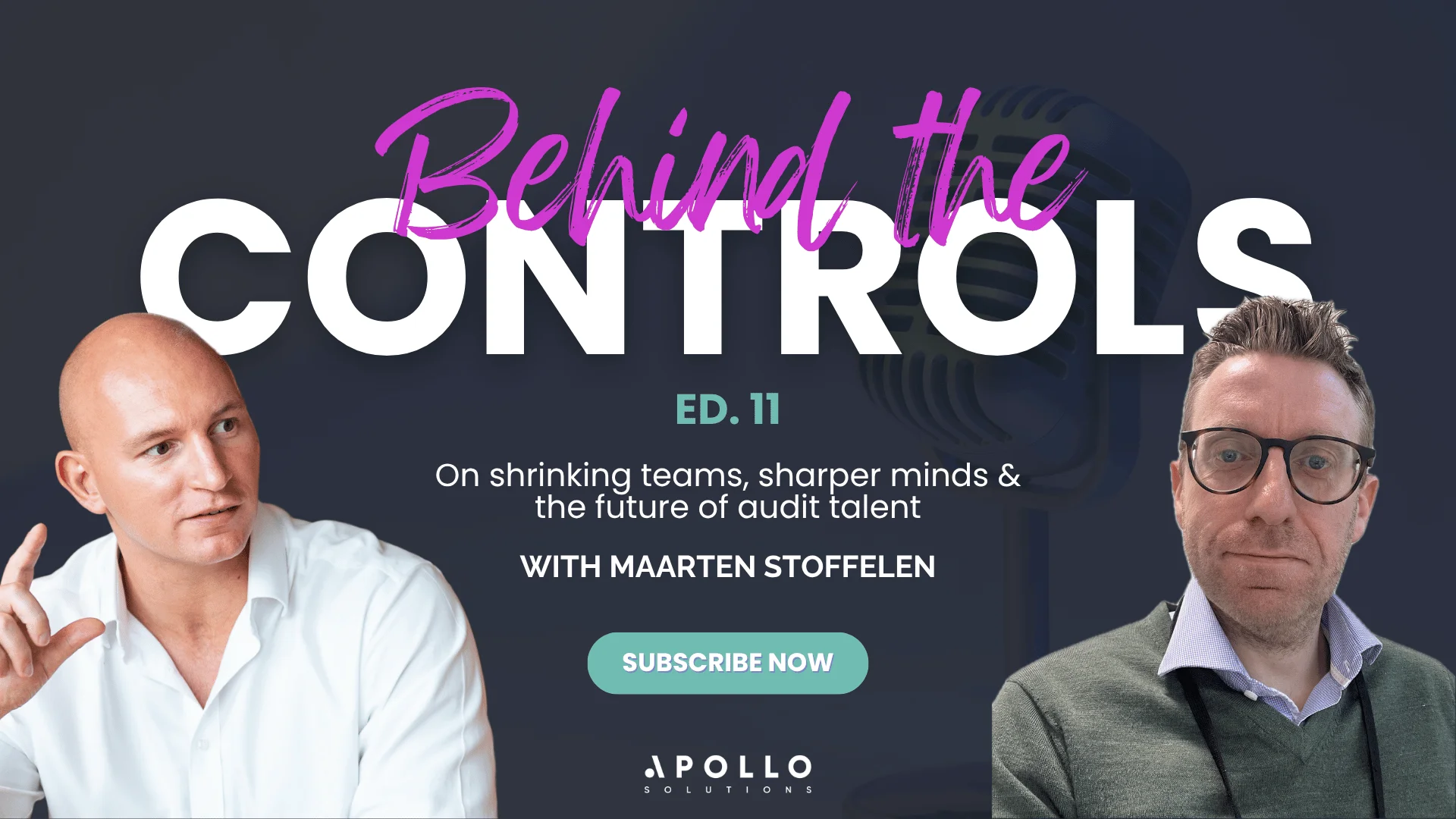
AI is reducing the need for junior auditors. Fewer juniors hired today means fewer seniors available in five to ten years. That, according to Maarten Stoffelen, is the biggest challenge internal audit has on its hands today.
For this edition of Behind the Controls, I sat down with Maarten, Internal Audit Director at DEME, the Belgian offshore energy, dredging, marine infrastructure and environmental remediation group.
His career spans almost 25 years, taking him from Big Four external audit into internal audit at a medical device company, travelling extensively around the globe, before stepping into finance leadership roles that took him to Colombia and back. He then served as finance director at a large construction company, before joining DEME in 2019 to set up its internal audit function from scratch.
We talked about what AI means for the future of talent, judgement and leadership in internal audit, and what the profession needs to do about it now.
Adopt, use and adapt continuously
Maarten’s philosophy on AI is straightforward: adopt it, use it, and adapt continuously. He uses it himself, every day, both personally and professionally. But he is clear on the risks that come with it.
"It has even gotten to the point where sometimes one can feel a bit lazy. AI can help you write an email that you would normally write yourself. We have to be careful with that.”
That self-awareness is the starting point for everything else he says about AI and the profession. The tool is genuinely useful. The risk is not the tool itself; it is what happens when people stop thinking because the tool is doing it for them.
The pipeline problem
The most structural challenge Maarten sees is not just about what AI does to the work. It’s about what it does to the talent pipeline, and that is a problem that cuts two ways.
The first is a numbers problem. Organisations facing budget pressures will invest in AI rather than in junior headcount. Where you might previously have needed two juniors, one may now suffice. Fewer juniors hired means fewer people developing into seniors. And traditionally, not all juniors who come through audit stay in audit.
"That is the biggest challenge we have on our hands today. We have to find a way to make sure that we have enough seniors in five to ten years' time."
The second is about what gets lost along the way. Junior auditors have historically developed professional judgement by doing the groundwork. Testing. Analysis. Research. Repeated exposure to how things actually work before being asked to form an opinion on them. AI compresses or removes much of that work. The experience that used to build scepticism and contextual understanding no longer needs to happen.
Universities need to adapt alongside this, according to Maarten. He sits on the advisory board for the Faculty of Business Economics at the University of Antwerp, and his view is that how students are assessed needs to change. If the majority of grades are still based on collecting information rather than defending and explaining it, universities are rewarding exactly the skill that AI now does automatically.
"Whenever they do their thesis, the majority of grades should be on the part where people explain what they have been doing and defend their thesis, rather than on collecting the information. That's what the machine can do for you today."
He raises a related point on offshoring. Organisations that have traditionally sent lower-end work to lower-cost locations may find it cheaper and simpler to do that work through AI instead, bringing it back in-house but through automation rather than people.
Never ban it. But make them do it without AI first
I asked whether Maarten would ever consider banning AI for certain tasks or certain team members. He didn’t hesitate:
"I would never ban it. In the past, banning things has never been the answer to coping with problems."
But he does have a view on how juniors should be onboarded. For the first one or two assignments, he thinks it’s worth making them work without AI. Not to deprive them of a useful tool, but to make sure they understand what the tool is actually doing for them later.
"Making them do the work without AI at least once or twice, to understand the process that AI is now going to do for them in the future. Since we have the basics, how do we continue from the basics towards the next step, towards the observation, etc.."
The role of management, in his view, is to keep asking questions. To keep pushing back. To keep making juniors explain what they found, where they found it, and what it means in the context of the specific business they are auditing. The machine can identify a theoretical risk. Only a human can translate that risk into the reality of a particular industry, company or business unit.
"The machine will tell you the theoretical risk, but you have to translate that risk towards your industry, your business, your company, your business unit. That is what we need from people going forward."
The interview room test
I recently came across a situation that stuck with me. An employee at a client’s company had been using AI to write their audit reports, and the output was very good. Well written, professional. But when they were pulled into a meeting to face off to a stakeholder, they could not answer any questions on the spot. That on-the-spot, critical thinking simply was not there.
Maarten recognised this immediately.
"That is 100% a real risk. That is where management needs to come in and make sure that in final meetings, it is not just the chief audit executive talking, but also the team. To give that experience to the people and to know what they are talking about."
I have seen another version of this too, in my role as a recruiter. Candidates caught looking at a second screen during a Teams interview, using AI to answer questions in real time. Once again, Maarten's view is that it is not using AI that is the problem. It is not being able to think on your feet without it.
His fix as an interviewer is to ask questions that cannot easily be answered by AI. Real examples. Situations that require the candidate to draw on genuine experience. As he puts it, when you ask for real live examples, you know quickly whether they are truthful or not.
The skills that will define great auditors
When asked which human capabilities will matter most in the AI era, Maarten pointed to three:
• Being technically savvy. Not just open to technology, but actively curious about it and able to use it with judgement.
• Empathy. In an interview or a stakeholder meeting, noticing when someone becomes nervous, and understanding what that signals, for example, is something a machine cannot do.
• Healthy scepticism. Towards people, towards data, and towards the output of AI itself.
On scepticism towards AI specifically, he makes a practical point. When an AI output includes a link to where it found the information, click it. Read it. Understand whether the source actually supports what the machine is telling you. It is the same discipline as footnotes in a university essay. The reference has to be real, and the auditor has to verify it.
Being concise is also a skill
One observation Maarten makes that does not always get enough attention: AI inflates. Ask it to turn a one-page summary into five pages and it will, within minutes. But if the person reading the report then uses AI to compress it back to one page, nothing has been gained. A lot of time has been wasted.
"We should all, at all times, avoid that. The AI that you use in your reporting should really add value towards the reporting and not just make sure to have more pages. From usual 20-page reports, you now go to 50-page reports that nobody is waiting for."
I raised the “so what” point in response, the idea that a report only matters if it lands a clear conclusion. Maarten agreed without hesitation. And that part, he says, has to come from a human.
The more technology you use, the more human interaction matters
Maarten makes a point near the end of our conversation that sits alongside everything else he says about AI and judgement. The more technology an organisation uses, the more important direct human interaction becomes.
"If it is an easy thing, it is efficient that AI answers your question. But if it is a complex problem, you really want to speak to someone."
That is also where his thinking on AI governance lands. He advocated within DEME for an AI board, a cross-functional group that looks at what systems are in use, what information goes where, what data might be leaving the organisation, and how to handle GDPR in an AI context. But he is not convinced most organisations do.
"I would really challenge everyone to think about whether they need that inside their organisation. A year ago, many of my peers at other organisations were not using AI yet. I am not sure whether they have already thought about implementing AI boards and the like."
The data security point sits behind all of this. Every piece of information fed into an AI tool is potentially accessible beyond the organisation. Competitors. Third parties. Anyone. As I noted, it is the same risk framework that applies to any third-party vendor. AI providers are third parties. The governance needs to reflect that.
Over to you
If you are leading an audit team, how are you making sure juniors build judgement rather than just output? And does your organisation have a formal approach to AI governance, or is it still being worked out as you go?
Drop your thoughts in the comments. I’d be interested to hear how different teams are navigating this.
Want more insights like this?
Subscribe to Behind the Controls to stay ahead of what’s shaping Audit, Risk and Compliance leadership, and how top professionals are navigating it.